CN >
CN >
Thermal Management for High-Power Electronics: How NF150-800 8W Thermal Pad Enables Efficient Heat Dissipation and Long-Term Reliability
Author:NFION
Date:2026-07-15 16:56:48
1. In the High-Power Era, Reliable Thermal Management Matters More Than Heat Dissipation Alone
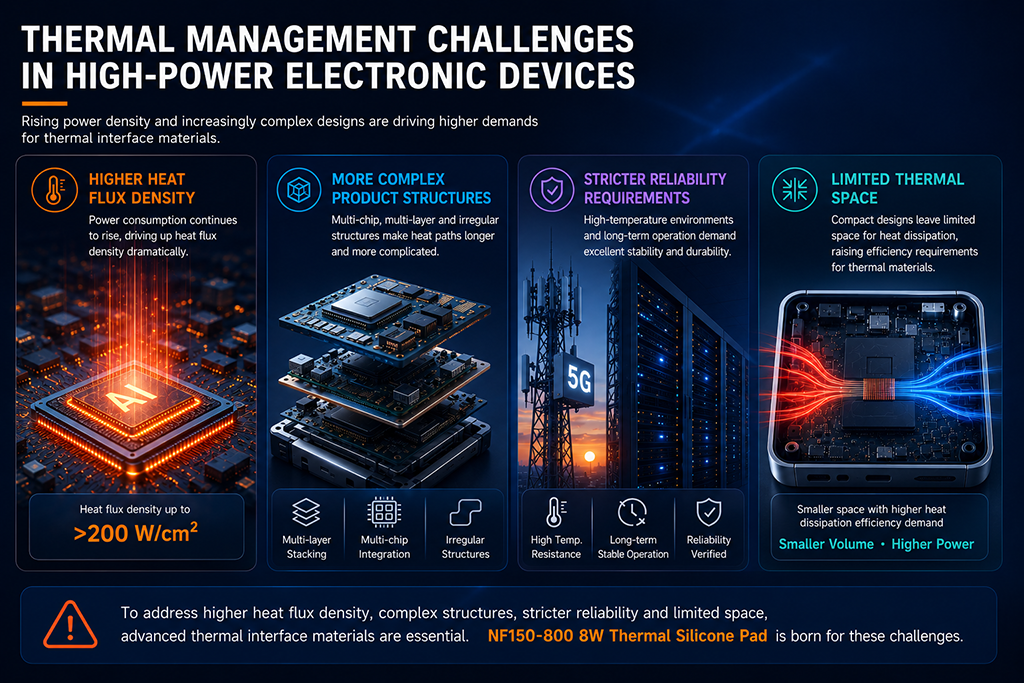
In the past, competition in the electronics industry was mainly focused on higher performance, richer functionality and innovative product designs. However, with the rapid development of artificial intelligence, 5G communications, edge computing, industrial automation and advanced electronic systems, electronic products are entering a new stage of evolution:
Higher performance, higher integration and higher power density are becoming defining characteristics of next-generation devices.
As chip computing capabilities continue to improve, the amount of heat generated per unit area is increasing significantly. At the same time, the trend toward smaller and more compact product designs limits the available space for traditional cooling solutions.
Under these conditions, how to efficiently transfer heat, reduce localized temperature buildup and maintain long-term operational stability has become a critical factor affecting product performance and reliability.
This challenge is particularly evident in applications such as:
● High-speed communication equipment;
● AI edge computing devices;
● Industrial electronic systems;
● Power electronic modules;
● High-performance smart devices.
In these applications, key components such as processors, power devices and communication modules often operate under continuous high-load conditions, creating increasing demands on thermal management performance.
Traditionally, thermal design focused mainly on factors such as heat sink size, airflow optimization and power consumption control. However, as electronic products become more compact and complex, simply increasing heat dissipation capacity is no longer sufficient.
Thermal management is evolving from a supporting design function into a critical capability that directly influences product performance, reliability and service life.
For high-power electronics, thermal management is not simply about selecting a material with higher thermal conductivity. Instead, it requires a comprehensive balance between:
● Heat transfer efficiency;
● Interface thermal resistance;
● Structural adaptability;
● Long-term reliability.
This is why 8W-class thermal interface materials are gaining increasing attention in high-power electronic applications.
2. Why Higher Thermal Conductivity Does Not Always Mean Better Thermal Performance
When selecting thermal interface materials, engineers often focus first on thermal conductivity.
For example:
● 3W/m·K;
● 5W/m·K;
● 8W/m·K.
A higher thermal conductivity value indicates stronger heat transfer capability within the material itself.
However, actual thermal performance in electronic devices depends on much more than material conductivity alone.
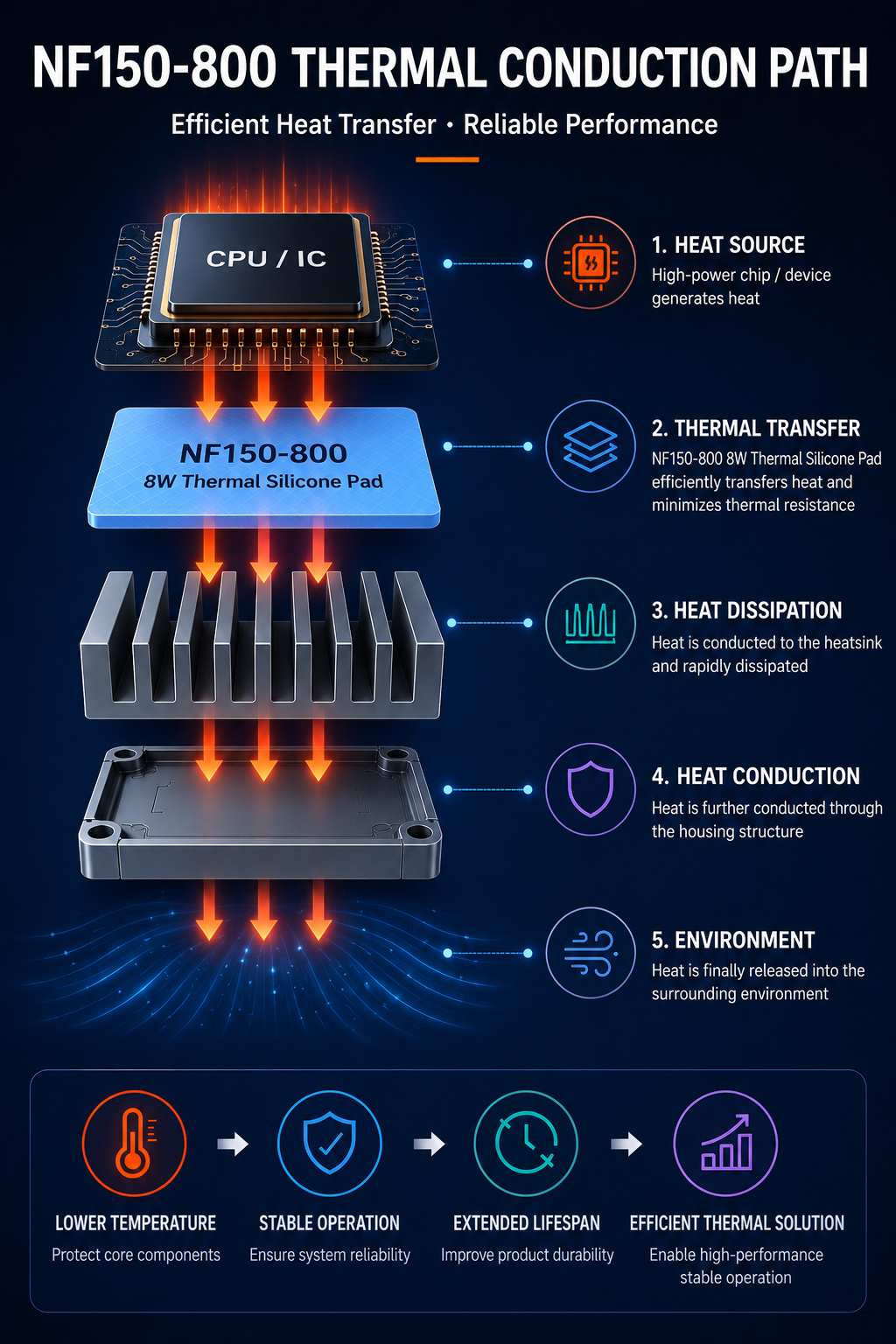
The real thermal transfer path is:
Heat Source → Thermal Interface Material → Heat Dissipation Structure → Ambient Environment
Any inefficiency throughout this path can negatively affect overall thermal performance.
2.1 Higher Thermal Conductivity Does Not Necessarily Mean Lower Thermal Resistance
In real-world assemblies, the surfaces of chips, heat sinks and metal structures are not perfectly flat.
Due to factors such as:
● Manufacturing tolerances;
● PCB warpage;
● Component height variations;
● Heat sink surface unevenness;
microscopic air gaps often exist between the heat source and the heat dissipation structure.
Because air has extremely low thermal conductivity compared with thermal interface materials, these gaps create additional thermal resistance and reduce heat transfer efficiency.
Therefore, an effective thermal interface material must not only provide high thermal conductivity, but also offer excellent gap-filling capability to minimize interface resistance.
2.2 Higher Thermal Conductivity Does Not Always Guarantee Long-Term Reliability
For high-power electronic applications, thermal materials must not only transfer heat efficiently but also maintain stable performance over extended operating periods.
For example:
● Communication equipment requires continuous operation;
● Industrial systems demand long-term reliability;
● Automotive electronics must withstand complex environments.
If thermal materials experience:
● Compression performance degradation;
● Reduced interface contact;
● Increased thermal resistance;
● Material aging;
the reliability of the entire electronic system may be affected.
Therefore, the true value of thermal interface materials lies not only in initial thermal performance, but also in maintaining stable performance throughout the product lifecycle.
2.3 Higher Thermal Conductivity Does Not Always Mean Better Structural Compatibility
Modern electronic devices feature increasingly complex internal structures.
Different components may involve:
● Height differences;
● Assembly tolerances;
● Irregular contact surfaces;
● Multiple heat sources.
If a thermal material is too rigid, it may fail to achieve sufficient interface contact, increasing thermal resistance.
If it is too soft, long-term mechanical stability may become a concern.
Therefore, an advanced thermal interface material must achieve a balance between:
Thermal performance, interface conformity and structural adaptability.
This balance represents the higher requirements that high-power electronic devices place on next-generation thermal materials.
3. How NF150-800 Builds a More Efficient Thermal Management Path
To address the growing thermal challenges of high-power electronics, NFION has developed:
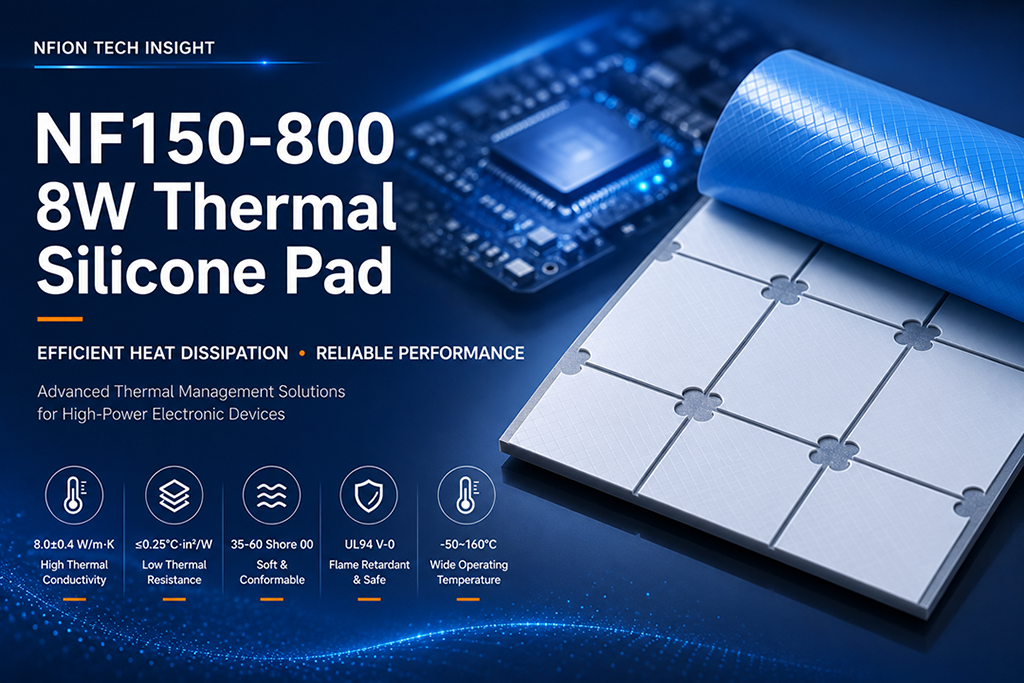
NF150-800 8W High Thermal Conductivity Low Thermal Resistance Silicone Thermal Pad
Rather than simply pursuing higher thermal conductivity, NF150-800 is designed to optimize heat transfer efficiency, interface performance, structural adaptability and long-term reliability.
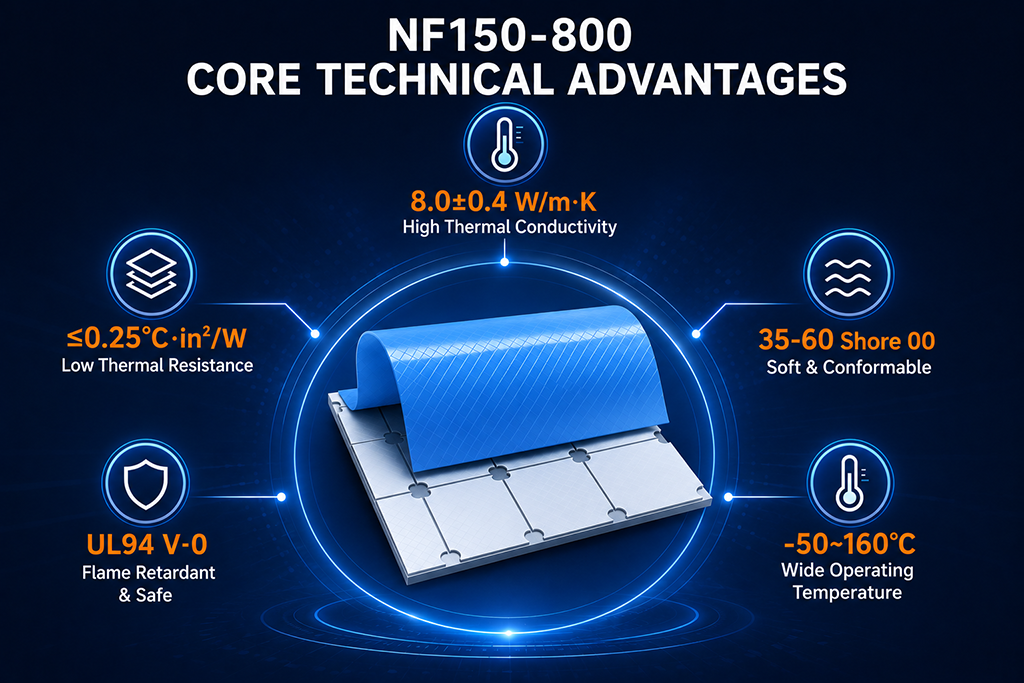
The key specifications are shown below:
| Property | Specification |
| Thermal Conductivity | 8.0±0.4 W/m·K |
| Thermal Resistance | ≤0.25℃·in²/W |
| Thickness Range | 0.5-10mm |
| Hardness | 35-60 Shore 00 |
| Tensile Strength | ≥0.12MPa |
| Elongation | ≥50% |
| Flame Rating | UL94 V-0 |
| Operating Temperature | -50~160℃ |
| Breakdown Voltage | ≥4KV |
| Volume Resistivity | ≥10⁸Ω·cm |
These characteristics enable NF150-800 to provide reliable thermal management performance for demanding high-power electronic applications.
3.1 8.0±0.4W/m·K High Thermal Conductivity for Faster Heat Transfer
NF150-800 adopts a high-performance thermal filler system to achieve:
8.0±0.4W/m·K thermal conductivity.
In high-power electronic devices, heat generated by chips and power components needs to be quickly transferred away from the heat source.
By creating an efficient thermal pathway, high thermal conductivity helps:
● Improve heat transfer efficiency;
● Reduce localized hotspots;
● Optimize temperature distribution;
● Enhance system stability.
However, thermal conductivity is only one part of thermal management design.
A truly effective thermal material must also consider thermal resistance, thickness, compression conditions and overall system structure.
3.2 ≤0.25℃·in²/W Low Thermal Resistance for Improved Interface Heat Transfer Efficiency
Compared with simply improving the thermal conductivity of a material, thermal resistance is often more closely related to actual heat dissipation performance in real applications.
NF150-800 delivers:
≤0.25℃·in²/W thermal resistance performance.
This enables the material to effectively reduce heat transfer barriers across the thermal interface.
For high-power electronic devices, low thermal resistance provides several important benefits:
Reduces heat accumulation;
Improves overall heat transfer efficiency;
Helps maintain a lower operating temperature for critical components;
Enhances long-term system reliability.
In practical thermal designs, the thermal interface material acts as a critical bridge between the heat source and heat dissipation structure. Reducing interface resistance allows the entire thermal path to operate more efficiently.
3.3 35-60 Shore 00 Flexible Design for Reliable Interface Contact
High thermal conductivity materials often face a common technical challenge:
Increasing thermal filler content can improve conductivity, but may also make the material harder and less conformable.
A material with excessive hardness may result in:
● Reduced contact area;
● Increased interface thermal resistance;
● Higher mechanical stress on sensitive components.
NF150-800 features:
35-60 Shore 00 hardness
combined with:
≥50% elongation.
This balanced mechanical design enables excellent interface conformity while maintaining effective heat transfer performance.
It is particularly suitable for applications where:
● PCB warpage exists;
● Component heights vary;
● Heat dissipation structures have dimensional tolerances;
● Reliable long-term contact is required.
By balancing softness and thermal performance, NF150-800 helps create a more stable thermal interface between heat sources and cooling structures.
3.4 0.5-10mm Thickness Range for Complex Structural Designs
Modern electronic devices often involve increasingly complex internal structures, where different components require different gap-filling solutions.
NF150-800 supports:
0.5-10mm thickness range.
This flexibility allows engineers to select suitable thicknesses according to actual product structures, including:
● Chip-to-heatsink interfaces;
● PCB-to-metal housing interfaces;
● Power module cooling structures;
● Multi-component thermal management applications.
Proper thickness selection improves interface contact and helps achieve optimized thermal performance.
3.5 UL94 V-0 Flame Rating and Electrical Insulation for Enhanced Safety
Beyond thermal performance, high-reliability electronic products also require excellent safety characteristics.
NF150-800 provides:
● UL94 V-0 flame retardant rating;
● ≥4KV breakdown voltage;
● ≥10⁸Ω·cm volume resistivity;
● -50~160℃ operating temperature range.
These properties enable NF150-800 to support not only efficient heat transfer but also reliable electrical safety in demanding electronic applications.
4. How NF150-800 Enables Thermal Management Upgrades for High-Power Electronics
As electronic systems continue to evolve, different application scenarios present different thermal management challenges.
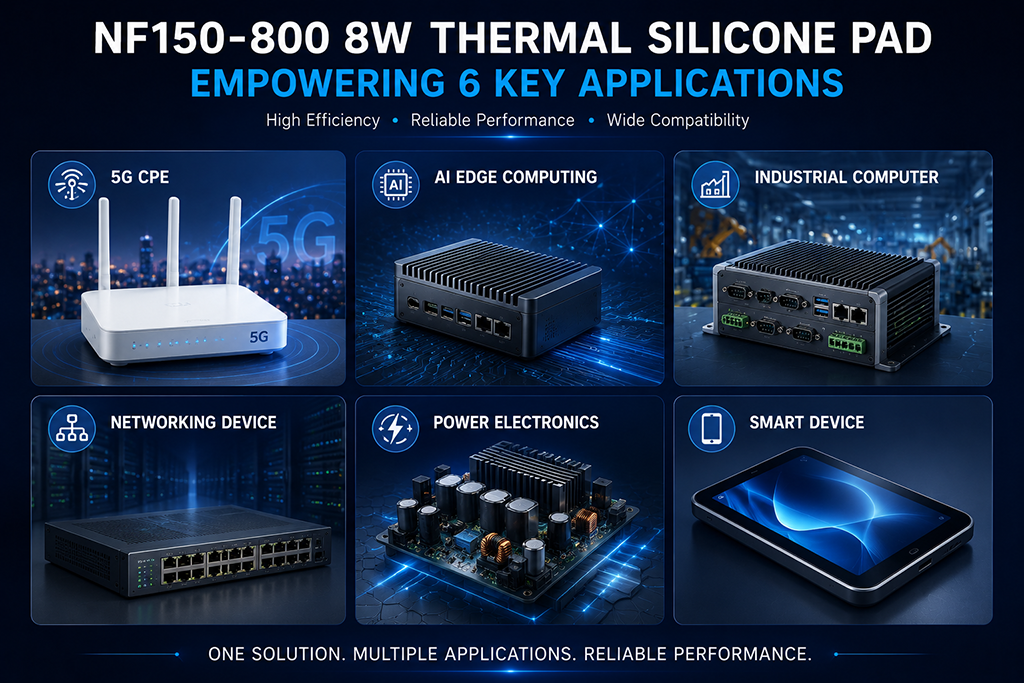
NF150-800 is designed to support a wide range of high-power electronic applications.
4.1 5G CPE and Communication Terminal Devices
5G CPE devices integrate multiple high-performance components, including:
● Baseband processors;
● RF modules;
● Wi-Fi chipsets;
● Power management components.
High-speed communication requires continuous data processing, which generates significant heat during operation.
At the same time, 5G CPE products typically prioritize:
● Compact design;
● Low noise operation;
● Long-term reliability.
Therefore, thermal solutions often adopt a structure such as:
Chip → Thermal Pad → Metal Heat Dissipation Structure → Product Housing
NF150-800 can be applied between heat-generating components and cooling structures to reduce interface thermal resistance and improve heat transfer efficiency.
4.2 AI Edge Computing Devices
The rapid development of AI applications has significantly increased demand for computing performance, while also creating higher thermal loads.
AI edge computing devices typically focus on:
● High heat flux density;
● Continuous operation;
● Hotspot control;
● Compact thermal design.
NF150-800 helps optimize the thermal transfer path:
CPU/GPU → Thermal Interface Material → Cooling Structure
By improving heat transfer efficiency, NF150-800 supports stable operation of high-performance computing devices.
4.3 Industrial Computers and Control Systems
Industrial electronic equipment often requires:
● Continuous operation;
● High reliability;
● Wide temperature adaptability.
NF150-800 provides:
-50~160℃ operating temperature capability
to support thermal management requirements in demanding industrial environments.
Its combination of thermal performance and reliability makes it suitable for industrial computing systems, control equipment and embedded electronic devices.
4.4 Networking Equipment
Networking devices such as:
● Switches;
● Servers;
● Gateways;
● Communication modules;
often contain high-performance processors and power components that generate considerable heat.
For these systems, stable thermal performance directly affects long-term operational reliability.
NF150-800 can be used between chips, modules and heat dissipation structures to create a more efficient thermal transfer pathway.
4.5 Power Electronics
Power electronic systems, including:
● Power modules;
● MOSFET applications;
● Power conversion systems;
● Control units;
typically generate concentrated heat during operation.
NF150-800 can be applied between power components and cooling structures to improve heat transfer efficiency and support reliable operation under high thermal loads.
4.6 High-Performance Smart Devices
As smart electronic products continue to integrate more functions and higher-performance chips, thermal management requirements are increasing.
NF150-800 is suitable for:
● High-performance smart devices;
● Intelligent control systems;
● Advanced electronic terminals.
It helps improve thermal reliability while supporting compact product designs.
5. NF150-800 Selection Guide: How to Choose the Right 8W Thermal Pad
Although 8W thermal pads provide excellent thermal performance, selecting the highest conductivity material is not always the best solution.
Proper material selection should be based on actual application requirements.
5.1 Select According to Thermal Power Requirements
High-power and high-heat-flux applications require advanced thermal materials capable of efficiently transferring large amounts of heat.
For these applications, 8W-class thermal pads provide enhanced heat transfer capability.
However, for lower-power devices, engineers should evaluate thermal requirements carefully and select the most suitable material grade.
5.2 Select the Appropriate Thickness According to Structural Gaps
Thermal pad thickness should match:
● Component height;
● Heat sink distance;
● Assembly tolerance;
● Compression requirements.
If the material is too thin, it may not completely fill interface gaps.
If it is too thick, the longer thermal transfer distance may increase thermal resistance.
Therefore, thickness selection is a critical part of thermal design optimization.
5.3 Validate Reliability Before Mass Production
Before product launch, thermal interface materials should be evaluated through comprehensive validation, including:
● Thermal performance testing;
● Temperature rise testing;
● Thermal cycling;
● Long-term aging testing;
● Assembly verification.
Through proper validation, engineers can ensure that thermal materials meet the reliability requirements of the complete electronic system.
6. From Materials to Thermal Management Solutions: How NFION Supports Product Innovation
For NFION, the value of thermal management materials goes beyond individual performance parameters.
An effective thermal solution requires consideration of multiple factors, including:
● Product structure;
● Heat generation characteristics;
● Thermal transfer path;
● Operating environment;
● Reliability requirements.
From material selection and sample validation to customized processing and mass production support, NFION works closely with customers to optimize thermal management designs.
Based on diverse electronic thermal management requirements, NFION provides a comprehensive portfolio of materials, including:
● Thermal silicone pads;
● Thermal gels;
● Thermal greases;
● Phase change thermal materials;
● Graphene thermal materials;
● Thermal conductive EMI absorbing materials.
By combining material innovation with application experience, NFION helps customers achieve more efficient, stable and reliable thermal management solutions.
7. Conclusion: Reliable Thermal Management for the High-Power Era
As electronic devices continue to evolve toward higher performance and greater integration, thermal management is becoming a critical factor influencing product reliability.
For high-power electronics, an excellent thermal interface material is not defined only by higher conductivity. Instead, it requires a balance between:
● Thermal performance;
● Structural adaptability;
● Long-term reliability.
NF150-800 combines:
● 8.0±0.4W/m·K high thermal conductivity;
● ≤0.25℃·in²/W low thermal resistance;
● 0.5-10mm thickness adaptability;
● Flexible interface conformity;
● UL94 V-0 flame resistance;
to provide a reliable thermal management solution for demanding high-power electronic applications.
More importantly, NF150-800 represents NFION’s continuous exploration of advanced thermal management technologies.
Moving forward, NFION will continue to focus on material innovation and collaborate with customers to develop more efficient and reliable thermal management solutions.
NFION — Thermal Management Begins with Materials. Reliability Goes Beyond Them.