CN >
CN >
Why Automotive Displays Need Thermal Management? Challenges from High-Brightness Screens to Smart Cockpits
Author:NFION
Date:2026-07-01 15:52:34
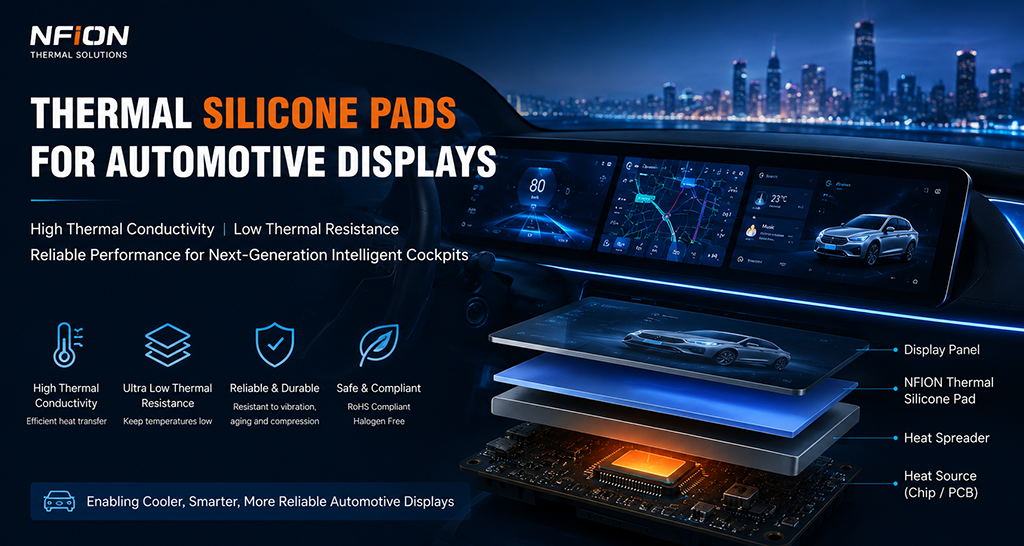
With the rapid development of new energy vehicles and automotive intelligence, automotive displays are becoming one of the most important interactive interfaces in modern intelligent cockpits.
From traditional instrument panels with basic information displays to today’s large central screens, digital dashboards, passenger entertainment displays, rear-seat entertainment screens, and multi-display intelligent cockpit systems, automotive displays are continuously evolving toward larger size, higher brightness, higher resolution, and greater integration.
However, while display performance continues to improve, a new technical challenge has become increasingly prominent — thermal management.
Larger screens, higher brightness levels, and more powerful computing capabilities all result in increased power consumption and heat generation. Without an effective thermal management solution, excessive heat can affect display performance, shorten component lifetime, and compromise the long-term reliability of intelligent cockpit systems.
Therefore, thermal management has become a critical part of automotive display design.
1. Automotive Displays Are Entering an Era of Large Size, High Brightness, and Intelligence
In the past, automotive display systems mainly served basic information display functions, including:
● Vehicle speed information;
● Fuel or battery status;
● Vehicle warning indicators;
● Basic navigation information.
Today, automotive displays in intelligent vehicles have evolved into integrated platforms combining:
● Information display;
● Human-machine interaction;
● Entertainment control;
● Vehicle function management;
● Intelligent services.
Modern electric vehicles are increasingly equipped with:
● Large central displays above 12 inches;
● Full digital instrument clusters;
● Multi-screen interactive systems;
● Intelligent cockpit terminals.
At the same time, consumer expectations for visual experiences continue to increase, driving automotive displays toward:
● Higher resolution;
● Higher brightness;
● Faster refresh rates;
● Wider color range;
● More immersive interaction.
However, these improvements also introduce greater thermal management challenges.
2. High-Brightness Displays Create Increasing Thermal Challenges
Compared with consumer electronics, automotive displays operate in much more demanding environments.
Vehicles must withstand:
● High-temperature exposure under sunlight;
● Direct solar radiation;
● Significant temperature fluctuations;
● Different climate conditions worldwide.
Under strong sunlight conditions, automotive displays need higher brightness to ensure drivers can clearly view important information.
Especially with the increasing adoption of high-brightness LCD solutions and Mini LED display technologies, automotive displays require more powerful backlight systems, which inevitably increases power consumption.
The relationship is straightforward:
Higher brightness → Higher power consumption → More heat generation → Greater thermal management requirements
If heat cannot be effectively dissipated, several problems may occur:
1. Brightness degradation
Long-term exposure to elevated temperatures can reduce display component performance and cause brightness attenuation.
2. Reduced display consistency
Uneven temperature distribution may lead to:
● Color deviation;
● Uneven brightness;
● Reduced display stability.
3. Shortened component lifetime
High temperatures accelerate aging of chips, circuits, and electronic components, reducing product reliability.
Therefore, efficient thermal management solutions have become essential for improving automotive display quality.
3. Intelligent Cockpit Development Is Driving New Thermal Management Requirements
The evolution of intelligent cockpits has transformed automotive displays from simple display modules into complex electronic systems.
Modern automotive displays typically integrate:
● Display driver ICs;
● System-on-Chip (SoC) processors;
● Power management ICs (PMIC);
● Touch control modules;
● Communication modules;
● AI computing units.
These high-performance components continuously generate heat during operation.
For example:
Intelligent navigation requires real-time data processing;
Voice assistants require continuous speech recognition;
Vehicle connectivity systems maintain communication links;
Multimedia functions require video processing capabilities.
As vehicle functions become more intelligent, higher-performance processors are required, resulting in increased heat flux density.
Therefore, future intelligent cockpit development will depend not only on computing performance and software capabilities but also on reliable thermal management technologies.
4. Why Can’t Automotive Displays Rely Only on Traditional Cooling Methods?
Many electronic devices solve thermal issues simply by adding heat sinks or cooling fans.
However, automotive displays have unique structural limitations.
1. Limited Installation Space
Automotive interior designs emphasize:
● Slim structure;
● Lightweight construction;
● High integration.
Traditional metal heat dissipation structures may increase thickness and weight, limiting product design flexibility.
2. Internal Air Gaps Affect Heat Transfer
Automotive displays contain multiple components, including:
● PCBs;
● Semiconductor chips;
● Metal brackets;
● Housing structures.
Small gaps often exist between different components due to assembly tolerances.
Since air has poor thermal conductivity, these gaps create additional thermal resistance and restrict heat transfer.
Therefore, thermal interface materials are required to fill these gaps and establish efficient heat conduction paths.
3. Automotive Applications Require Higher Reliability
Compared with consumer electronics, automotive electronic systems require much longer service life and higher reliability.
Automotive displays must withstand:
● High-temperature environments;
● Cold-start conditions;
● Thermal cycling;
● Long-term vibration.
Therefore, thermal management materials must provide not only excellent thermal conductivity but also:
● Long-term stability;
● Good compressibility;
● Aging resistance;
● Electrical insulation performance.
5. Thermal Interface Materials Become a Key Solution for Automotive Display Cooling
In automotive display thermal management systems, thermal interface materials (TIMs) play an essential role in connecting heat sources with heat dissipation structures.
By filling microscopic gaps between heat-generating components and cooling structures, TIMs reduce thermal resistance and improve heat transfer efficiency.
Typical applications include:
1. Display Driver IC Thermal Management
Display driver ICs generate continuous heat during operation.
Thermal silicone pads or thermal gels can help transfer heat away from the chip efficiently, reducing operating temperature and improving system stability.
2. SoC Processor Cooling
Intelligent cockpit systems require powerful computing capabilities, and high-performance SoCs generate significant heat during operation.
High-performance thermal interface materials help reduce chip temperature rise and improve system reliability.
3. Backlight Module Thermal Management
LED backlight systems are one of the major heat sources in automotive displays.
Optimized thermal pathways help reduce optical degradation and extend display lifetime.
6. What Performance Requirements Do Automotive Display Thermal Materials Need?
For automotive applications, thermal management materials must meet strict performance requirements.
High Thermal Conductivity
Efficiently transferring heat from chips and electronic components improves overall thermal performance.
Common thermal conductivity levels include:
● 2 W/m·K;
● 3 W/m·K;
● 5 W/m·K;
● 10 W/m·K;
● 15W/m·K;
● Higher-performance thermal grades.
Low Thermal Resistance
Actual cooling performance depends not only on thermal conductivity but also on:
● Material thickness;
● Interface contact quality;
● Thermal resistance.
Low thermal resistance materials minimize heat transfer loss.
Excellent Compression Performance
Because automotive display structures involve assembly tolerances, materials need:
● Flexible conformability;
● Gap-filling capability;
● Long-term recovery performance.
High Reliability
Automotive thermal materials must withstand:
● High-temperature aging tests;
● Humidity testing;
● Thermal cycling;
● Vibration reliability testing.
7. Future Automotive Display Development Will Further Accelerate Thermal Management Innovation
Future automotive display technologies will continue evolving:
● Ultra-large displays;
● Mini LED automotive displays;
● OLED automotive displays;
● AR-HUD head-up displays;
● Multi-screen intelligent cockpit systems;
● AI-powered interaction.
These technologies will bring higher power density and more complex thermal challenges.
The future competition in automotive technology will not only focus on:
Display size;
Resolution;
Smart functions;
but also:
Display technology + Computing capability + Thermal management performance.
Advanced thermal management solutions will become a fundamental technology supporting the next generation of intelligent vehicles.
8. NFION: Enabling Advanced Thermal Management Solutions for Automotive Displays
As a professional thermal management material solution provider, Shenzhen Nuofeng Electronic Technology Co., Ltd, under the brand NFION, focuses on the research, development, and application of high-performance thermal interface materials.
For applications including new energy vehicles, intelligent cockpits, and automotive electronics, NFION provides:
● Thermal gels;
● Thermal conductive EMI absorbing materials;
● Customized thermal management solutions.
Through high thermal conductivity, low thermal resistance, and reliable material design, NFION helps customers optimize the thermal performance of automotive displays and electronic systems, improving product stability and service life.
From high-brightness displays to intelligent cockpits, from simple information screens to future automotive intelligent interaction platforms, thermal management is becoming one of the key technologies driving automotive electronics forward.
Driving thermal innovation through advanced materials and enabling more reliable intelligent cockpit experiences.