CN >
CN >
What Is the Pump-Out Effect in Thermal Interface Materials (TIMs)?
Author:NFION
Date:2026-06-09 14:07:45
As electronic devices continue to become smaller, faster, and more powerful, thermal management has become a critical factor in ensuring performance, reliability, and product lifespan.
From AI servers and high-performance computing systems to electric vehicles (EVs) and industrial power electronics, Thermal Interface Materials (TIMs) play a vital role in transferring heat from heat-generating components to cooling solutions.
However, engineers often observe that thermal performance gradually degrades after long-term operation, even when initial cooling performance is satisfactory. One of the primary causes behind this phenomenon is the Pump-Out Effect.
What Is Pump-Out Effect?
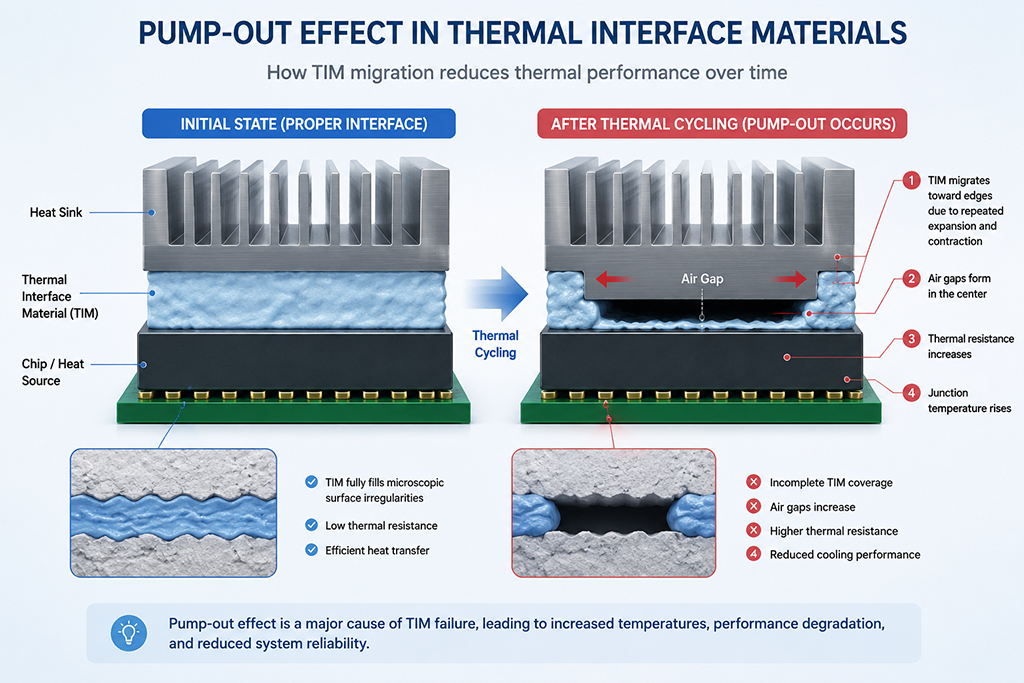
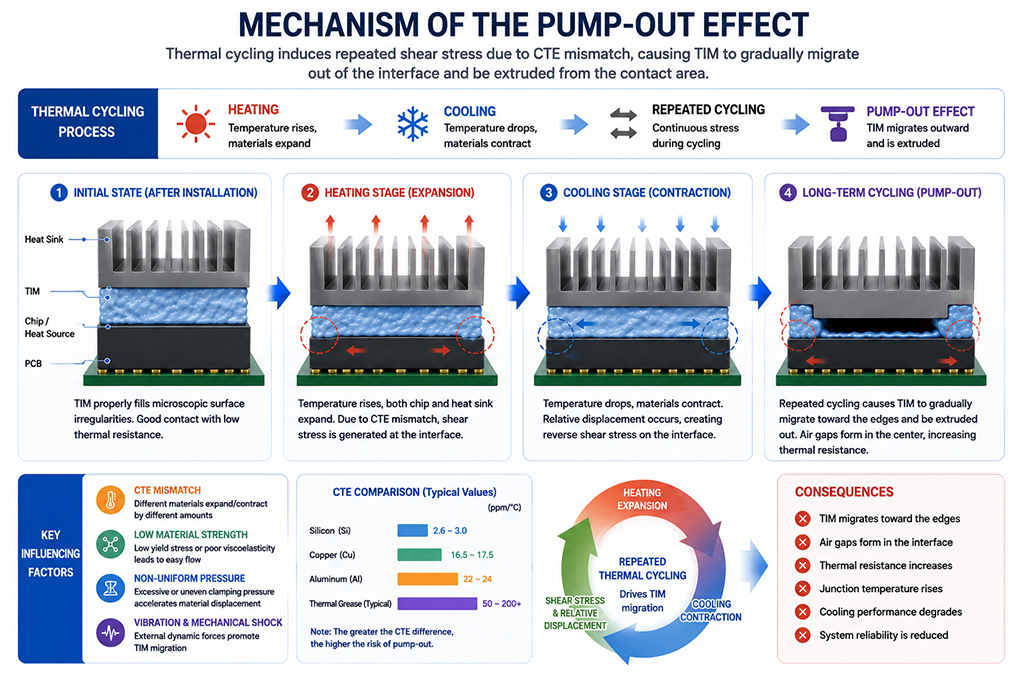
Pump-Out Effect refers to the gradual migration or extrusion of a thermal interface material from the contact interface between a heat source and a heat sink during operation.
As the TIM is displaced from the interface, air gaps begin to form, increasing thermal resistance and reducing heat transfer efficiency. In severe cases, excessive pump-out can lead to overheating, performance throttling, and even device failure.
The phenomenon is commonly observed in thermal greases and certain soft TIM formulations subjected to repeated thermal cycling.
What Causes Pump-Out Effect?
1. Thermal Expansion Mismatch
Different materials within an electronic assembly have different coefficients of thermal expansion (CTE).
During repeated heating and cooling cycles:
▪ Semiconductor chips expand and contract
▪ Heat spreaders deform slightly
▪ Heat sinks experience dimensional changes
These microscopic movements create shear forces that gradually push the TIM away from the interface.
This repeated motion acts much like a miniature pump, giving rise to the term “Pump-Out Effect.”
2. Insufficient Viscoelastic Properties
TIMs with low yield stress or poor structural stability are more susceptible to flow under mechanical stress.
Materials that lack adequate adhesion and elasticity tend to migrate more easily during long-term operation.
3. Excessive Interface Pressure
While mounting pressure improves thermal contact, excessive or uneven pressure distribution can accelerate material displacement and edge accumulation.
4. Mechanical Shock and Vibration
Applications such as EV power modules, industrial equipment, and telecom systems often experience continuous vibration.
These dynamic forces can further promote TIM migration and pump-out over time.
How Does Pump-Out Affect Thermal Performance?
Increased Thermal Resistance
TIMs are designed to fill microscopic surface irregularities.
Once the material migrates away:
▪ Contact area decreases
▪ Air gaps increase
▪ Heat transfer pathways become interrupted
As a result, interface thermal resistance rises significantly.
Higher Operating Temperatures
Increased thermal resistance limits heat dissipation efficiency, causing junction temperatures to rise.
Higher operating temperatures may lead to:
▪ Performance degradation
▪ Thermal throttling
▪ Reduced power output
Reduced Reliability
Long-term exposure to elevated temperatures accelerates:
▪ Solder fatigue
▪ Material aging
▪ Package degradation
▪ Device failure
Increased Maintenance Costs
In mission-critical applications such as data centers, energy storage systems, and electric vehicles, TIM degradation can result in costly maintenance and downtime.
Which TIMs Are Most Vulnerable to Pump-Out?
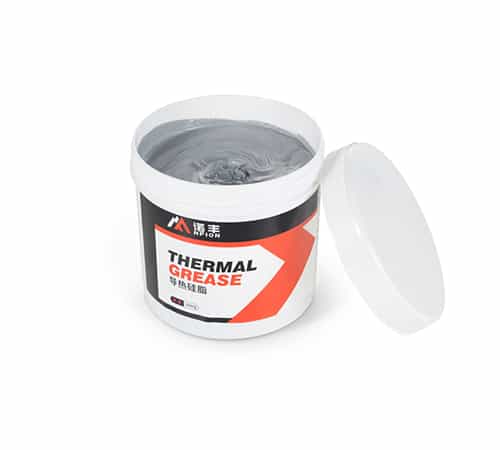
Thermal Grease
Thermal grease is the most common TIM affected by pump-out.
Advantages:
▪ Low thermal resistance
▪ Easy application
▪ Cost-effective
Challenges:
▪ Material flowability
▪ Oil separation
▪ Long-term pump-out risk
Thermal Gel
Thermal gels offer improved compliance and stress absorption.
Compared with traditional greases, optimized thermal gels generally exhibit better pump-out resistance.
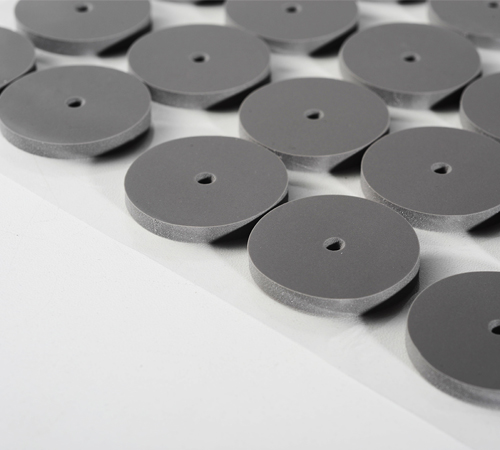
Thermal pads are solid-state materials with excellent dimensional stability.
As a result, they experience little to no conventional pump-out behavior.
Phase Change Materials (PCMs)
PCMs soften at operating temperatures and solidify upon cooling.
Their unique phase-transition mechanism helps maintain interface coverage and significantly improves pump-out resistance.
How Can Pump-Out Effect Be Minimized?
Select High-Reliability TIMs
Material selection is the most effective way to reduce pump-out risk.
Ideal TIMs should provide:
▪ Strong adhesion
▪ Stable filler distribution
▪ Low oil separation
▪ Excellent thermal cycling performance
Optimize Rheological Properties
Advanced formulations with improved yield stress and viscoelasticity can better resist migration under thermal stress.
Improve Mechanical Design
Uniform mounting pressure and optimized clamping structures help reduce localized stress concentrations.
Adopt Advanced Thermal Solutions
For high-reliability applications, engineers increasingly choose:
▪ Thermal gels
▪ Phase change materials
▪ Advanced composite TIMs
These technologies provide superior long-term thermal stability.
NFION's Approach to Pump-Out Prevention
As thermal demands continue to increase in AI computing, electric vehicles, renewable energy systems, and industrial electronics, long-term TIM reliability becomes more important than ever.
Nofeng focuses on developing advanced thermal interface materials with enhanced resistance to pump-out through optimized filler systems, rheological engineering, and interface stability design.
By improving thermal cycling durability and long-term performance stability, Nofeng helps customers achieve more reliable thermal management solutions for next-generation electronics.
Conclusion
Although often overlooked, Pump-Out Effect is one of the most critical factors affecting the long-term reliability of thermal interface materials.
As power densities continue to rise, evaluating TIM performance requires more than simply comparing thermal conductivity values. Pump-out resistance, thermal stability, and lifecycle reliability are becoming equally important selection criteria.
Choosing the right TIM can significantly improve thermal performance, extend product lifespan, and reduce maintenance costs across demanding applications.