CN >
CN >
Can Silicone Thermal Pads Dissipate Heat on Their Own? Many People Misunderstand Their Real Function
Author:NFION
Date:2026-03-24 14:38:08
In electronic thermal design, Silicone Thermal Pads have become almost standard components. From network switches and power modules to automotive electronics, they are widely used across various applications.
However, one question often comes up in practice:
Can silicone thermal pads dissipate heat by themselves?
Many people instinctively assume that since they are “thermal” materials, they should also help with heat dissipation. But from a thermal management perspective, this is a common misunderstanding.
The answer is simple: silicone thermal pads cannot dissipate heat on their own. Their core function is heat transfer, not heat dissipation.
Understanding this is the first step toward proper thermal design.
Why Is This Question Often Misunderstood?
This misconception usually comes from three common cognitive biases:
1. Misleading terminology
The word “thermal” in silicone thermal pads often leads people to associate them with heat dissipation, although the two are fundamentally different.
2. Visual misunderstanding in applications
Silicone thermal pads are typically placed between heat-generating chips and heat sinks. When temperatures drop, people tend to attribute this effect to the pad itself.
3. Incorrect attribution of results
Temperature reduction happens because heat is effectively transferred away—not because a material is actively dissipating heat.
In short, the pad participates in the process but does not perform the dissipation function.
Heat Conduction ≠ Heat Dissipation
To understand the real role of silicone thermal pads, it is essential to distinguish between two concepts:
Heat Conduction
The transfer of heat within a material from a higher temperature region to a lower temperature region.
Heat Dissipation
The release of heat into the surrounding environment through convection, radiation, or cooling systems.
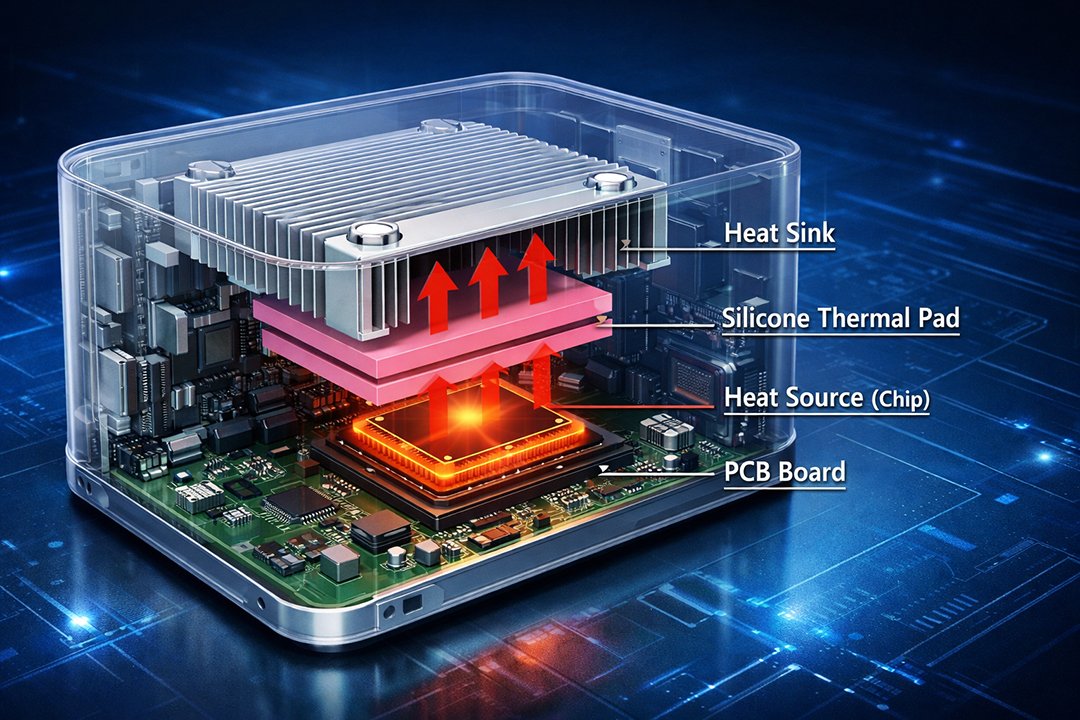
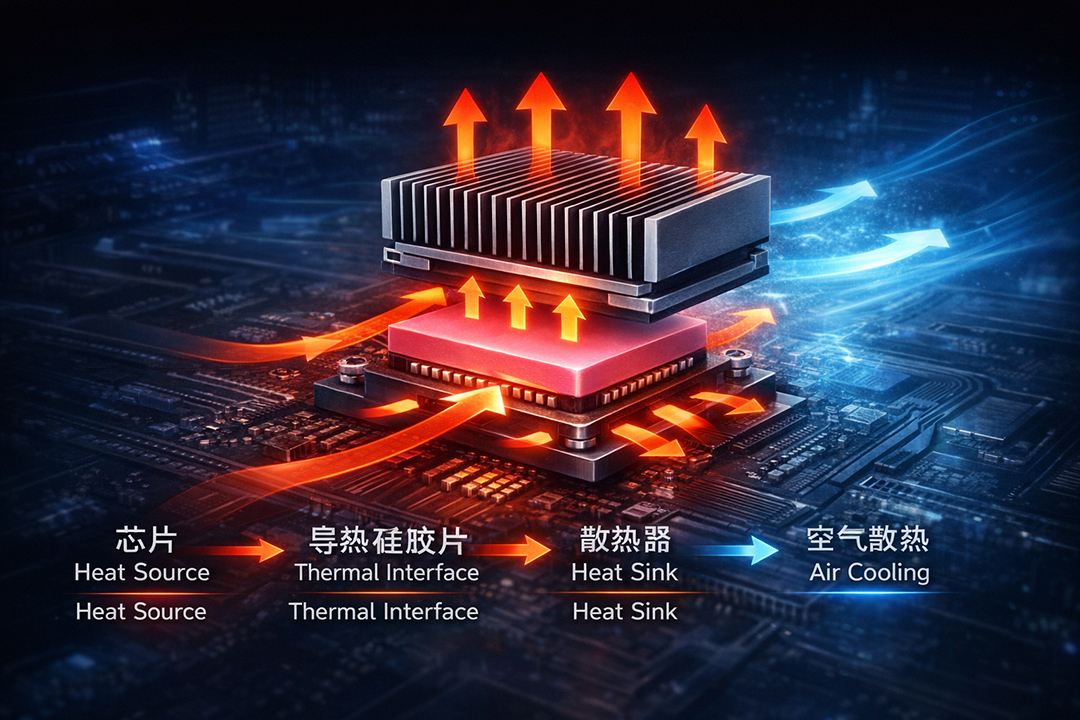
In electronic systems, heat typically follows this path:
Chip → Thermal Interface Material → Heat Sink → Air
Each component plays a distinct role:
● Chip: generates heat
● Thermal material: transfers heat
● Heat sink: dissipates heat
Silicone thermal pads belong to Thermal Interface Materials (TIMs) and are responsible for improving heat transfer, not dissipating heat.
What Does a Silicone Thermal Pad Actually Do?
If it does not dissipate heat, what is its real value?
The answer is: it solves the problem of poor heat transfer.
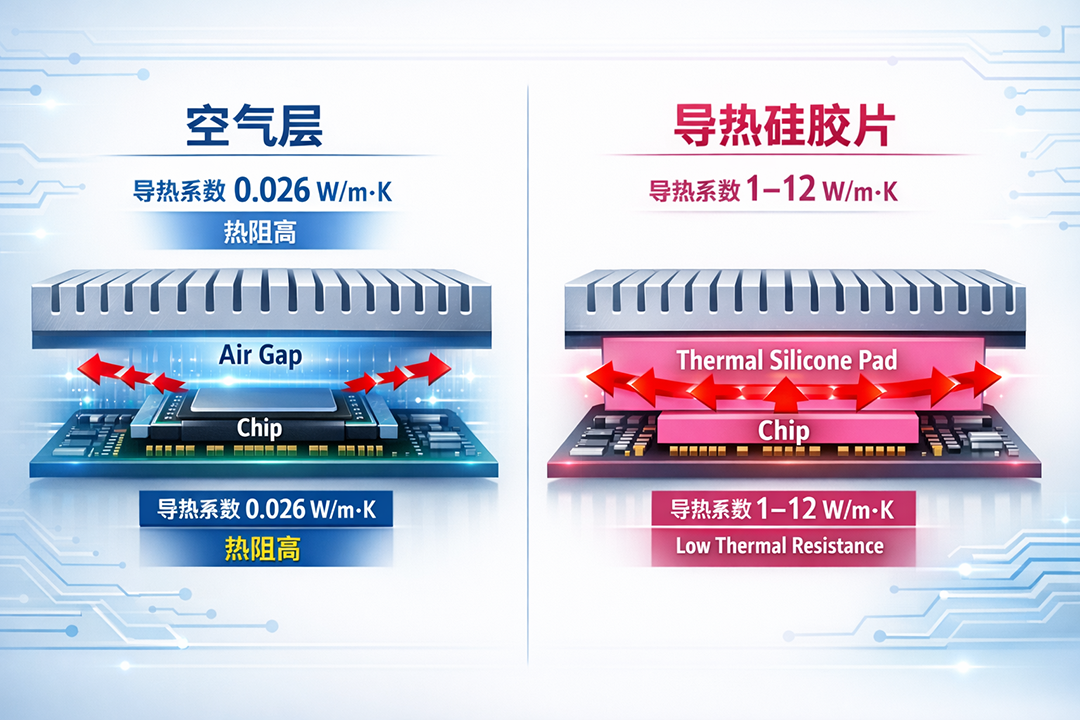
In real-world assemblies, chip and heat sink surfaces are not perfectly flat. Microscopic air gaps exist, and air has extremely low thermal conductivity:
● Air: approx. 0.026 W/m·K
● Silicone thermal pad: approx. 1–12 W/m·K
Without a thermal interface material, these air gaps become major thermal resistance barriers.
The role of a silicone thermal pad can be summarized as:
1. Gap Filling
Its softness and compressibility allow it to fill surface irregularities.
2. Reducing Thermal Resistance
Replacing air with a conductive material significantly improves heat transfer.
3. Creating a Stable Thermal Path
It ensures a reliable and continuous path for heat to flow toward the heat sink.
In essence, it does not “handle” heat—it enables heat to move efficiently.
Why Does Cooling Get Worse Without It?
A common issue in engineering practice is:
A good heat sink, but still high temperatures.
The reason is often that heat never effectively reaches the heat sink.
Air gaps between the chip and heat sink create a thermal resistance layer, blocking heat flow.
In simple terms:
● A powerful heat sink is useless without proper contact
● Poor thermal paths prevent heat from being removed
The core value of a silicone thermal pad lies in:
Replacing air gaps with a low-resistance thermal bridge.
For example, in network switches, the main chip is usually connected to a heat sink or metal enclosure through a thermal pad. Without it, temperatures can rise rapidly even with a well-designed cooling structure.
Understanding Its Role from an Engineering Perspective
From a system perspective, thermal management can be seen as a chain:
● Chip: heat source
● Heat sink: heat removal
● Silicone thermal pad: connection between them
In this chain, the role of the silicone thermal pad is clear:
It is neither a heat producer nor a heat remover, but a “heat transporter.”
Many thermal problems are not due to insufficient cooling, but because heat cannot be effectively transferred.
And silicone thermal pads are the key to solving this issue.
Conclusion
As electronic devices continue to evolve toward higher power density, greater integration, and smaller size, thermal management has become a critical factor in system reliability.
Although silicone thermal pads may seem like simple materials, they play a crucial role by filling gaps, reducing thermal resistance, and enabling efficient heat transfer.
In essence, they neither generate nor eliminate heat—they act as the “heat carriers” within the system.
And in many cases, this seemingly small component determines whether a thermal system truly works.